Smart Lighting Won't Slash Your Bill — Controlling Your Aircon Will
Honest numbers for Singapore homes: LED lighting is already efficient, so smart lighting saves less than you think. The real electricity savings come from controlling your air-conditioning — here's how smart AC control works and what it actually saves.
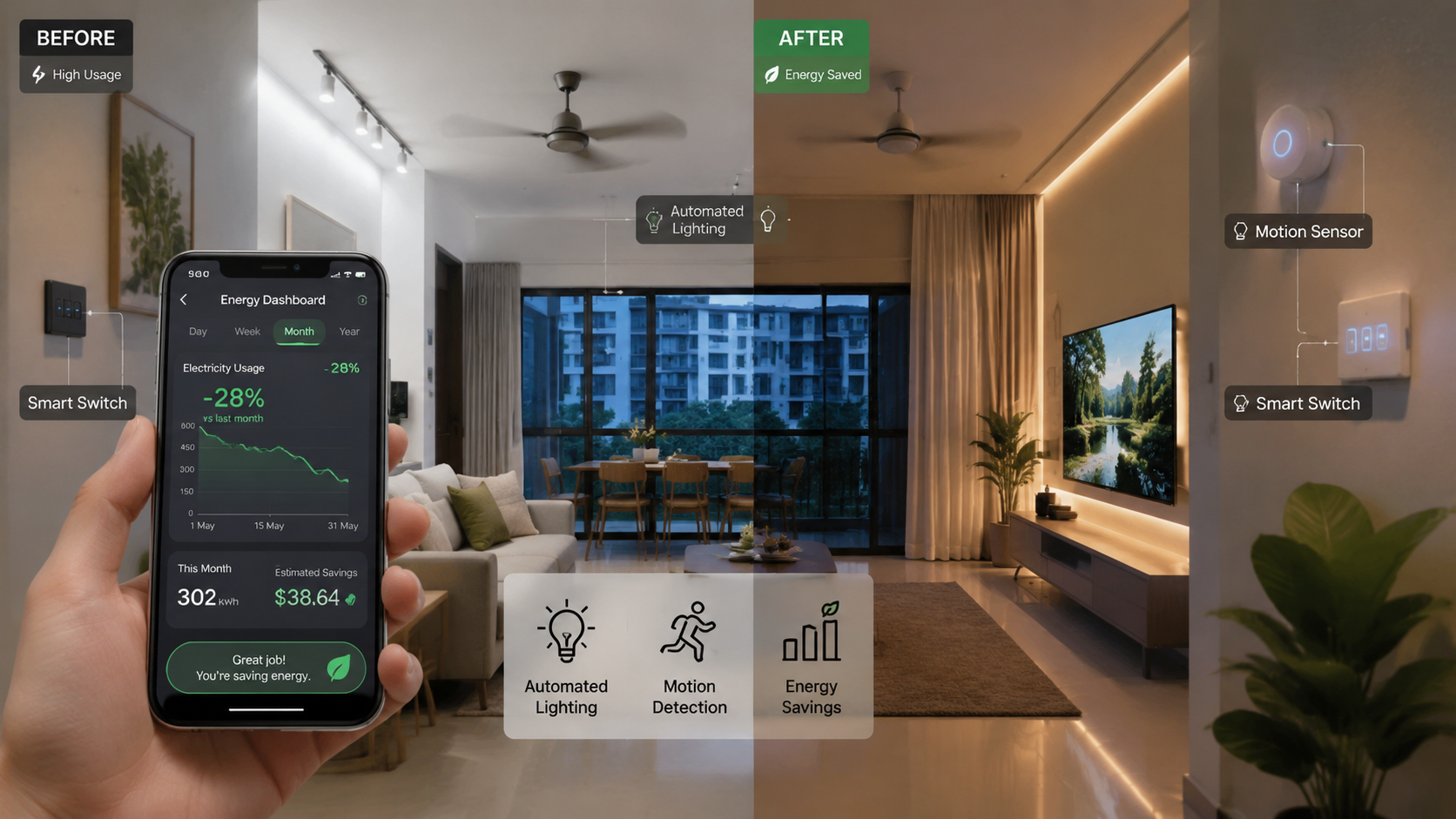
Search "smart lighting energy savings" and you'll find bold claims — bills cut by half, lights that pay for themselves. Here's the honest version for Singapore homes: if your goal is a lower electricity bill, smart lighting is the wrong place to start. The right place is the appliance humming away in every bedroom: your air-conditioner.
The Truth About Lighting Savings
Singapore homes have largely completed the one lighting upgrade that mattered: switching to LED. A modern LED downlight draws around 7–10 watts. Even a generously lit living room runs on less power than a single laptop charger.
Automating lights that already sip power produces correspondingly small savings — for most flats and landed homes, lighting is a single-digit percentage of the bill. Motion sensors and schedules trim a slice of that slice. It's real, but it's coffee money.
No — it's excellent for convenience, scenes, security presence simulation, and never coming home to a dark house. Install it for those reasons. Just don't install it expecting the bill to drop.
Where the Money Actually Goes: Air-Conditioning
Air-conditioning is typically the single largest item on a Singapore household bill — commonly a third or more of total consumption, and higher in landed properties running several split units or ducted systems through humid nights.
That ratio is why the same automation logic that barely moves the needle on lighting becomes genuinely valuable on AC. Cutting even 15–20% of your cooling consumption is worth more than eliminating your lighting consumption entirely.
What Smart AC Control Actually Does
With your units integrated into a system like Home Assistant, savings come from visibility and habits enforced automatically:
- Real-time status of every unit — see at a glance what's running, at what setpoint, from one dashboard. Most families are surprised by what's been left on.
- Empty-room shut-off — occupancy sensors turn cooling off when a bedroom or study has been empty for 20 minutes.
- Window and door awareness — a contact sensor pauses the AC when the balcony door is open, instead of cooling the neighbourhood.
- Smarter schedules — pre-cool the bedroom 30 minutes before sleep, step the setpoint up at 2am when deep sleep needs less cooling, off at 7am. No one has to remember anything.
- Setpoint discipline — every degree colder costs meaningfully more. Holding 25°C instead of 22°C is one of the highest-impact changes a household can make, and automation makes it stick.
- Left-on alerts — a notification when a unit has been running in an empty house beats discovering it after a weekend away.
Because HomeAuto sets this up with local control, your automations don't depend on a cloud service or your internet connection — the logic runs inside your home.
What This Looks Like on the Bill
Every home differs, so treat these as conservative illustrations rather than promises: households that add occupancy-based shut-off, schedules, and setpoint discipline typically trim 10–25% of their cooling consumption. On a bill where cooling is the largest single item, that is a monthly saving you can actually see — and it compounds through every hot season for the life of the system.
Compare that with automating LED lights that were barely costing anything to begin with, and the priority order is clear.
The Right Order for a Singapore Smart Home
- 1. Integrate and automate the aircon — biggest load, biggest saving.
- 2. Add occupancy and contact sensors — they power the shut-off and window automations.
- 3. Then smart lighting — for scenes, security, and comfort, with savings as a small bonus.
Want to See What Your Aircon Is Really Costing You?
Free WhatsApp consultation · Home Assistant specialists · 500+ Singapore homes automated · Local control, 1-year workmanship warranty
WhatsApp +65 8807 7147Related Guides
Smart Home
/smart-home